
In a market saturated with automation promises, the conversation has noticeably shifted. Industry consensus for 2026 is no longer about adding more robots; it’s about making them smarter through software. This pivot places the wes at the center of a high-risk transformation, promising to act as a digital air traffic controller for all warehouse activities. Proponents claim these platforms can dynamically orchestrate human and robotic workforces to dissolve bottlenecks in real-time.
Table of Contents
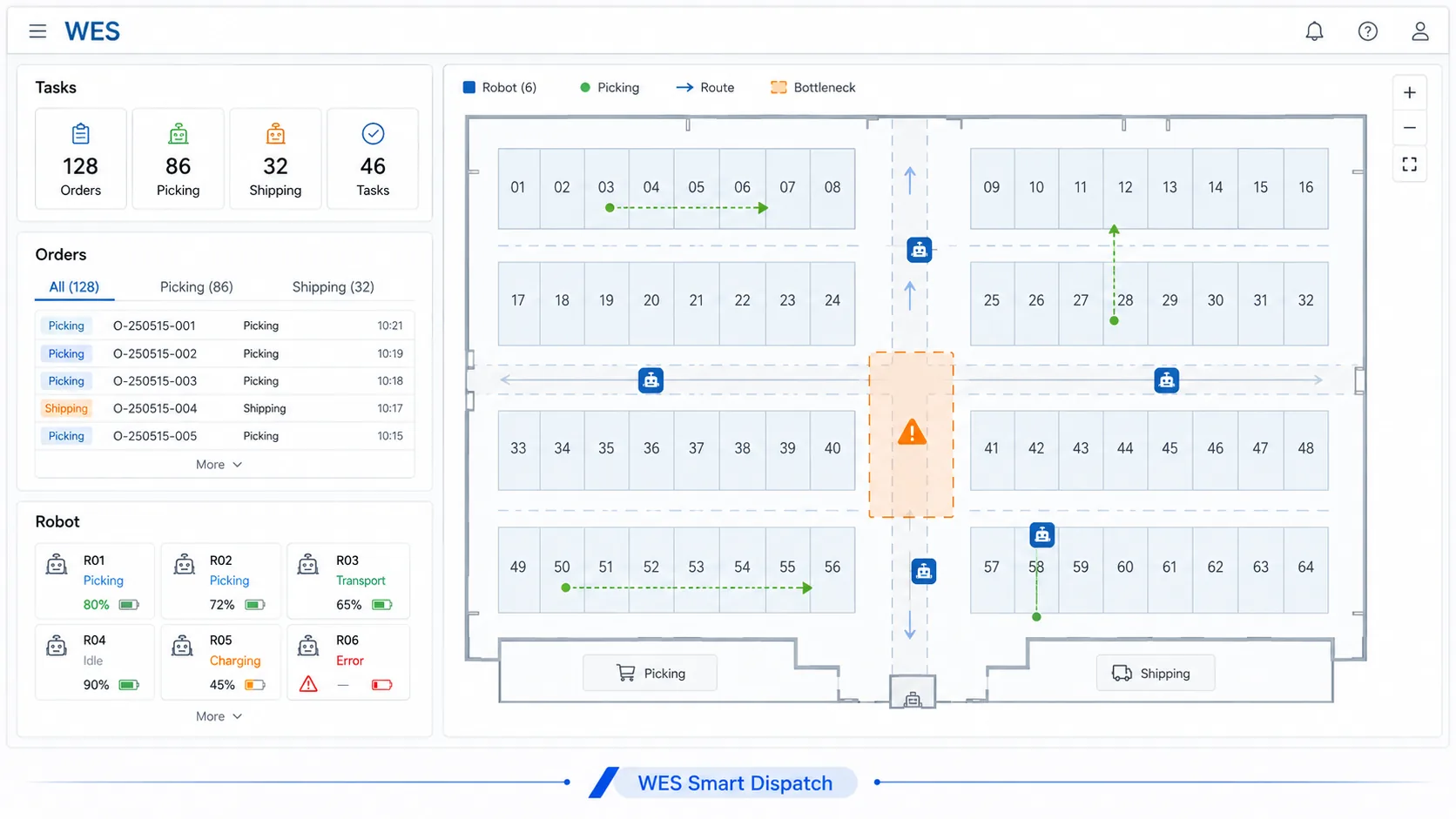
However, our investigation reveals a more complex reality. The vendor promises obscure significant integration challenges and operational risks. While the concept of a central software brain is compelling, the path to achieving this unified control is riddled with complexities, making a deep, skeptical analysis of any wes essential before commitment.
Mapping the 2026 wes Landscape
To understand the current market, one must first distinguish the wes from its older cousins: the Warehouse Management System (WMS) and the Warehouse Control System (WCS). Traditionally, a WMS managed inventory and order logic at a high level, while a WCS directly commanded the hardware. The wes was designed to bridge the gap, providing real-time, decision-making intelligence that a WMS often lacks.
Established technology giants like Körber, Manhattan Associates, and Honeywell Intelligrated dominate the space, each offering a proprietary vision of orchestration. The main selling point is a “single pane of glass” to manage a diverse ecosystem of automated guided vehicles (AGVs), autonomous mobile robots (AMRs), and human workers.
The key differentiator for these systems is the sophistication of their decision-making algorithms. We’re talking about more than simple scripts; they employ machine learning to adapt to changing order volumes and resource availability on the fly. This very complexity, however, creates a new set of unseen challenges.
You might also like: Outdoor amr Exposes a Critical Flaw in US Automation
Deconstructing Vendor Claims
The sales pitch often describes a seamless, plug-and-play future. The reality on the ground tells a different story. While vendors claim their wes can “eliminate bottlenecks,” our analysis reveals that it can just as easily become the primary bottleneck itself if not implemented with meticulous planning.
One major issue is the integration with legacy WMS platforms. Many companies have spent decades and millions of dollars on their existing WMS, which often becomes a source of data conflicts and process friction when a new wes is layered on top. One anonymous operations director for a major 3PL firm noted in an industry forum, “Our WES and WMS are in a constant battle for who is the ‘source of truth,’ causing daily operational hiccups.”
In addition, the promise of orchestrating “diverse” automation fleets often comes with a significant catch. Many wes solutions are heavily optimized for their own company’s robotics or a limited set of certified partners. This creates a new, more insidious form of vendor lock-in, where adopting a software platform subtly dictates your future hardware purchasing decisions for years to come.
The Integration Paradox of wes
A significant tension lies at the heart of the modern wes. These systems are sold on the principle of unifying disparate systems, yet their proprietary nature often fosters fragmentation. According to a recent report from the analyst firm Gartner, the lack of standardization and open APIs between competing WES platforms is a major concern for enterprise-level adopters who operate globally with multiple automation vendors.
This software-centric approach also introduces significant data governance and security questions. A wes ingests an unprecedented amount of real-time operational data, from worker performance metrics to robot pathing information. This centralized data hub creates a high-value target for cyberattacks, and its use for monitoring human productivity is already attracting scrutiny from labor regulators in Europe and North America.
Right now, there are few, if any, industry-wide standards governing how this data can be used, stored, or secured. This lack of oversight means early adopters are navigating a minefield of potential compliance and liability risks, a topic rarely mentioned in vendor sales pitches. The technical debt incurred by choosing a closed, inflexible wes today could become a costly burden tomorrow.
You might also like: Humanoid robots Warning: Hype Collides With Reality in 2026
The Bottom Line on wes
Ultimately, the wes represents a powerful but double-edged sword. It is undeniably the logical next step in warehouse optimization, but it is not the simple, turnkey solution that many vendors portray it to be. The shift from hardware-centric to software-centric automation introduces a new layer of abstract complexity that many organizations are culturally and technically unprepared to manage. The dream of a perfectly orchestrated warehouse is tantalizing, but the reality is that a poorly chosen wes can create more problems than it solves.
Critical Signals to Watch:
- A key signal is: The battle between proprietary ecosystems and the emergence of open-source or standards-based WES initiatives that promise true interoperability.
- Observe: New regulations from bodies like the EU AI Act or OSHA specifically targeting the use of AI in monitoring human workers in logistics environments.
- Pay attention to: The integration of more advanced predictive and prescriptive analytics within the wes, moving from reactive orchestration to proactive resource allocation.
- Look for: The publication of independent Total Cost of Ownership (TCO) studies that go beyond software licensing to include the hidden costs of integration, data migration, and ongoing maintenance.
For any professional in this space, ignoring the rise of the wes is not an option. That said, proceeding with a healthy dose of skepticism and a rigorous focus on open standards and long-term flexibility is the only way to ensure the investment pays off. The risks are not in the technology itself, but in the rush to adopt it without fully understanding its hidden complexities.